
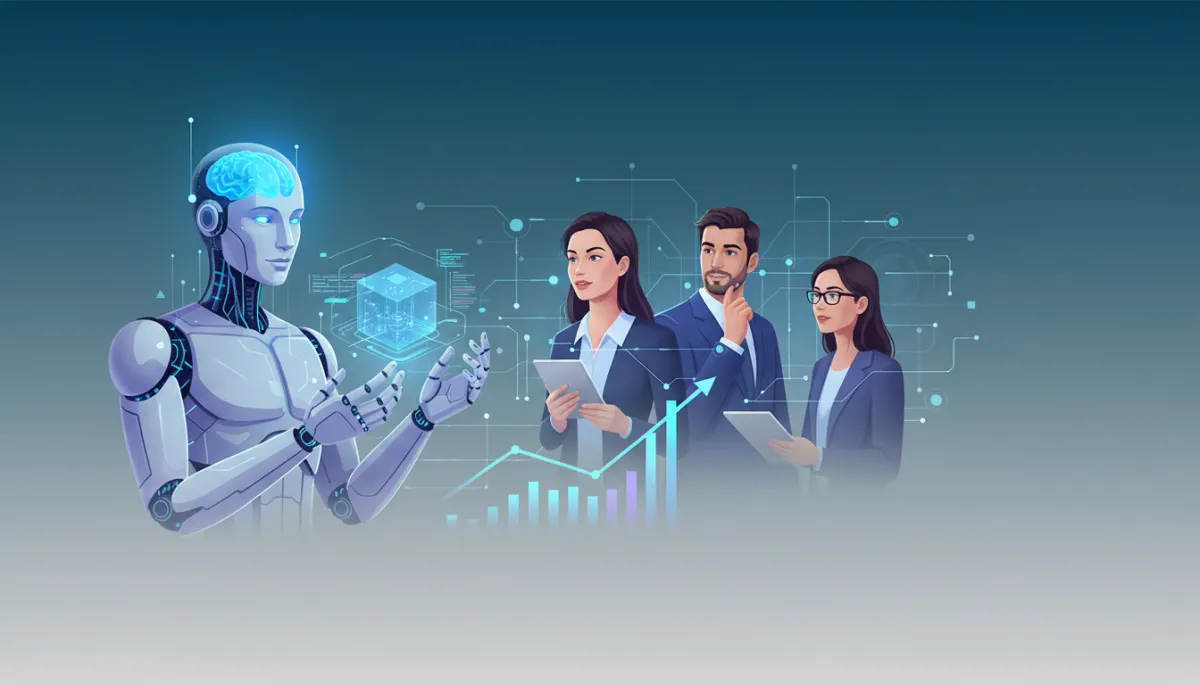
Modern office with AI assistant dashboard and human employees

AI Employees: Transforming the Future of Work

March 29, 20261 min read

AI, Future of Work

AI Employees: Your New Digital Colleagues at Work

AI employees are no longer science fiction. They are software-based “workers” that support human teams by handling repetitive, data-heavy tasks with speed and accuracy.

Custom HTML/CSS/JAVASCRIPT

What Is an AI Employee?

An AI employee is an intelligent system that performs tasks a human employee would normally do: answering customer questions, summarizing reports, drafting emails, or monitoring data for issues. Unlike traditional software, it can learn from interactions, respond in natural language, and adapt to new situations over time.

Benefits for Teams and Businesses

When thoughtfully introduced, AI employees free people from low-value tasks so they can focus on strategy, creativity, and relationships. Common advantages include:

  • 24/7 availability for customer support and internal requests

  • Consistent quality in routine tasks like data entry or reporting

  • Faster decisions through real-time analysis of large datasets

Manager collaborating with an AI assistant interface on a laptop

Teams using AI employees often reclaim hours each week for higher-value work.

💡 Pro Tip: Treat your AI employee like a new hire—define its role clearly, train it with real examples, and review its work regularly.

AI employees are not here to replace people, but to reshape roles. The organizations that benefit most are those that combine human judgment with AI speed, building workplaces where technology quietly handles the busywork and people do what only people can do.

Artificial Intelligence (AI) refers to computer systems designed to perform tasks that normally require human intelligence. These tasks include learning from data, recognizing patterns, understanding language, making decisions, and solving problems. AI systems use algorithms and large amounts of data to improve their performance over time. Examples of AI include voice assistants, recommendation systems on streaming platforms, self-driving technology, and tools that can analyze images or translate languages. By automating complex or repetitive tasks, AI helps increase efficiency, supports decision-making, and enables new innovations in fields such as healthcare, education, business, and transportation.

Mounir Drissi

Artificial Intelligence (AI) refers to computer systems designed to perform tasks that normally require human intelligence. These tasks include learning from data, recognizing patterns, understanding language, making decisions, and solving problems. AI systems use algorithms and large amounts of data to improve their performance over time. Examples of AI include voice assistants, recommendation systems on streaming platforms, self-driving technology, and tools that can analyze images or translate languages. By automating complex or repetitive tasks, AI helps increase efficiency, supports decision-making, and enables new innovations in fields such as healthcare, education, business, and transportation.

Back to Blog

© 2026 IsecureLead by Andromeda Marketing LLC. All rights reserved.